For decades, the way people discover services, cultural experiences, and local opportunities has remained largely the same. Search engines, brochures, tourism websites, and directories have attempted to fill the gap. But human needs are rarely as simple as the categories those tools provide.
People do not search in keywords. They search in questions.
A family relocating to Pittsburgh might ask, “Where can my teenager find an after-school art program near the North Side?” A visitor might wonder, “Is there a way to experience local history, live jazz, and river views in the same day?” A caregiver could ask, “Which organizations in Pittsburgh help families with both food and job readiness?”
Traditional tools struggle to answer questions like these. They map keywords, not lived experiences.
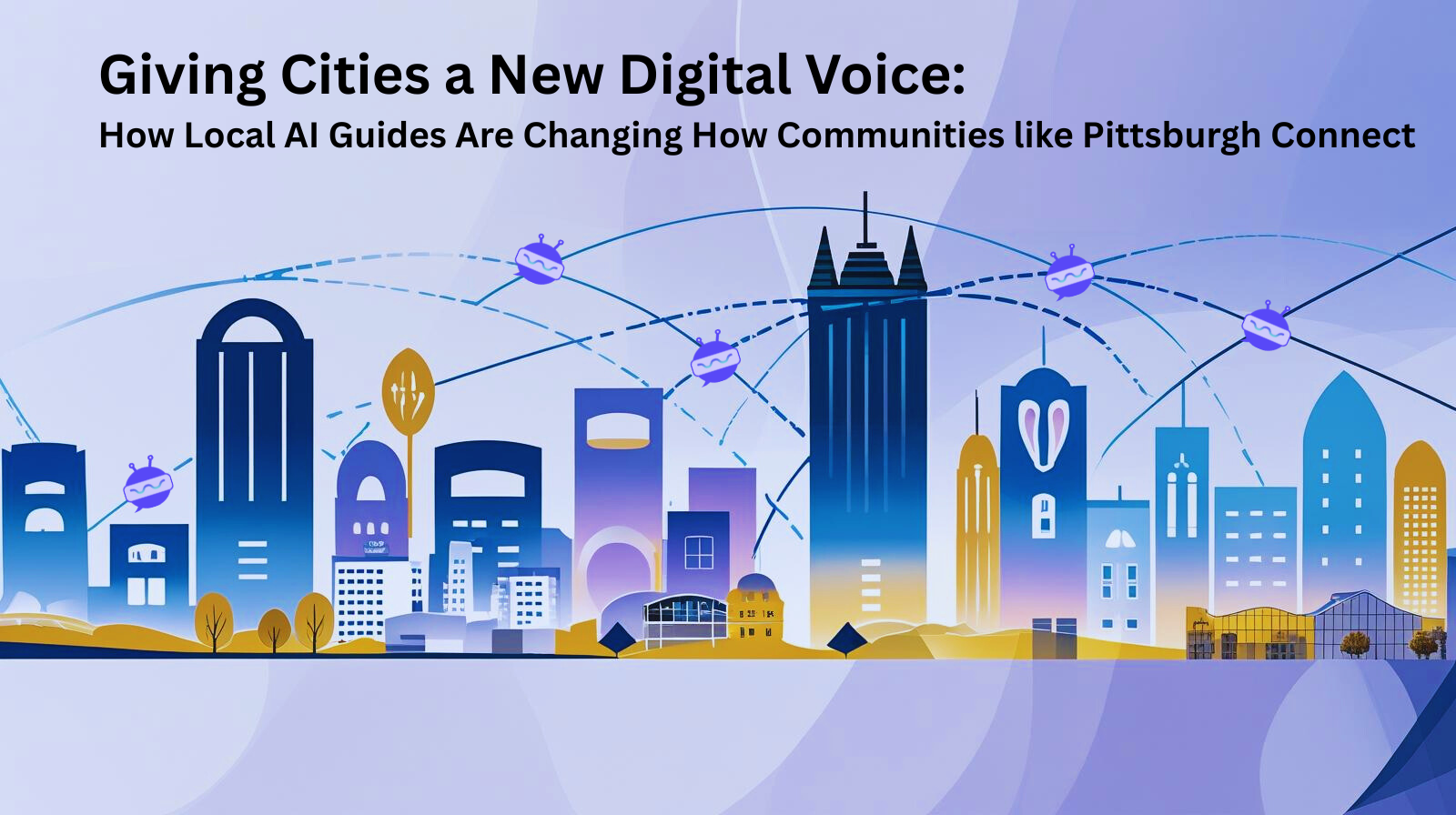
A new kind of digital infrastructure is emerging that aims to address that gap. Local AI Guide Networks allow organizations to train conversational AI Guides that speak in their voice, understand their programs, and help people act, not just browse. When connected across a region, these Guides form a knowledge network grounded in real community expertise.
Rather than browsing websites or combing through directories, people can now ask questions and receive answers directly from the organizations that serve, teach, preserve, heal, convene, and welcome.
Local AI Guides are designed to represent real institutions. From the Pittsburgh Cultural Trust to Carnegie Mellon University to VisitPittsburgh to the Forbes Funds and beyond, these Guides are trained to answer questions with accurate, up-to-date information, rooted in organizational voice and purpose.
The goal is not to replace websites or human connection. It is to make local expertise accessible through conversation.
A resident using these networks can ask direct questions and get direct answers.
“What are some ways to explore Pittsburgh’s cultural history and riverfront in one day?”
The Pittsburgh Cultural Trust and VisitPittsburgh Guides can collaborate to recommend a combined itinerary: a morning at the Heinz History Center, an afternoon walking tour of North Shore public art, and an evening river cruise that highlights regional heritage.
Rather than producing a list, it produced a pathway. Instead of a search results page, the AI Guides respond with program descriptions, transportation details, and links to purchase tickets. It provides context, clarity, and a next step.
Residents gain access to reliable, locally informed guidance on education, housing support, recreation, volunteering, or cultural experiences. They no longer have to navigate dozens of websites or hope they choose the right keywords.
Nonprofits and impact organizations gain visibility that reflects what they do, not just what their name suggests. A family seeking mentorship resources may find Big Brothers Big Sisters, but also discover mentoring programs at Amachi Pittsburgh or The Mentoring Partnership. AI Guides help organizations show up based on what they offer, not how optimized their website is.
Tourism and cultural institutions benefit when visitors can explore the city through interest and curiosity, rather than lists and categories. Instead of simply finding attractions, visitors can find meaningful experiences shaped by local arts, history, and identity.
City leaders can view the network as a form of civic infrastructure, helping people navigate services, discover local assets, and better understand their own communities. It can support economic development, newcomer integration, and cross-sector collaboration.
Critics note that directories have tried to solve this problem for years, often with mixed results. The difference here is that AI Guides do not wait for people to browse or click. They respond. They guide and connect. They help people take action.
They give organizations a way to speak for themselves, in their own language, around the clock.
Most organizations already have the information needed to power an AI Guide. From program descriptions to service details to mission language to upcoming events to volunteer needs and impact stories, all the information on webpages, in pdfs, on videos on YouTube, every piece of content becomes the foundation for the Guide. From there, it can be refined, updated, and expanded.
When connected to other Guides, it begins to refer, suggest, and collaborate.
The network strengthens with every new voice that joins.
What emerges is not a new website. Not a better directory. Not a chatbot. It is a whole new way for communities to express themselves digitally through knowledge, context, voice, and connection.
It does not replace human expertise. It reveals it.
And in a time when information is everywhere but meaningful connection is scarce, that might be exactly what cities need.